


7 Environmental Signals Every Survivalist Must Know How to Read
It was mid-afternoon when the forest went completely silent. Not gradually — abruptly, like someone had switched off a speaker. The birds stopped. The insects stopped. Even the wind seemed to hold its breath. Sarah had been hiking for three hours and had never experienced anything like it. She stood frozen on the trail, heart rate climbing, unsure whether to run or stay still. She stayed still. Thirty seconds later, she heard the low, deliberate movement of a large animal passing through the undergrowth forty metres to her left. It never came closer. When the sounds of the forest slowly returned — first a single bird, then insects, then the full chorus — she understood that she had just witnessed something remarkable: the environment had warned her, and she had listened. Reading the environment is the oldest survival skill in existence. Long before weather apps, emergency alerts and GPS trackers, humans survived by decoding what was happening around them — the behaviour of animals, the shape of clouds, the smell of the wind, the texture of the soil. This guide covers the seven most critical environmental signals, with practical techniques, common mistakes and a kit to support serious situational awareness.
BARBARA COSTA
5/1/20266 min read
Why Environmental Reading Is a Survival Multiplier
Situational awareness isn't an innate talent — it's a trained habit. It starts with a decision: to stop looking only at the path directly ahead and begin observing the entire system around you.
The natural environment is a constant communication system. Every element — from a bird's behaviour to a cloud formation — is connected to everything else. When you learn to decode those connections, you anticipate problems before they become crises.
The 7 Critical Environmental Signals
Signal 1: The Silence That Screams
Sudden silence is one of the most powerful warning signals in any natural environment. When birds and insects stop abruptly, the system has activated an alarm. Common causes include a large predator moving through, a human presence, or a sharp drop in atmospheric pressure preceding a storm.
The correct response is to stop immediately, crouch if possible, and observe silently for two to three minutes before making any movement. Do not continue walking — each step could bring you closer to the source of the disruption.
Signal 2: Bird Language
Birds are the forest's most accurate alarm system. A short, repetitive, sharp alarm call means a nearby threat. The direction of the bird's gaze during the alarm is the key: looking upward indicates an aerial predator — hawk, falcon, eagle; looking horizontally indicates a ground predator — snake, large mammal, human. When multiple species alarm simultaneously, the threat is significant.

Signal 3: Cloud Reading for Weather Prediction
The sky is the most accessible barometer in the world.
Cirrus clouds — high, thin filaments resembling a horse's tail — indicate that a frontal system is approaching. When they appear in large numbers and progressively thicken through the day, expect rain or storms within 24 to 48 hours.
Cumulonimbus — the tall, dark tower with an anvil shape at the top — is the clearest possible signal of violent storm with lightning, hail and wind gusts. When you spot one, the only correct response is to find shelter immediately. Never remain in an open field, near isolated trees or on a hilltop.
Nimbostratus — a uniform, thick grey layer covering the entire sky — announces prolonged, persistent rain. Less dramatic than cumulonimbus but equally important for shelter planning.
Garmin Forerunner 165, Running Smartwatch, Colorful AMOLED Display, Training Metrics and Recovery Insights, Black


Signal 4: Tracks and What They Reveal
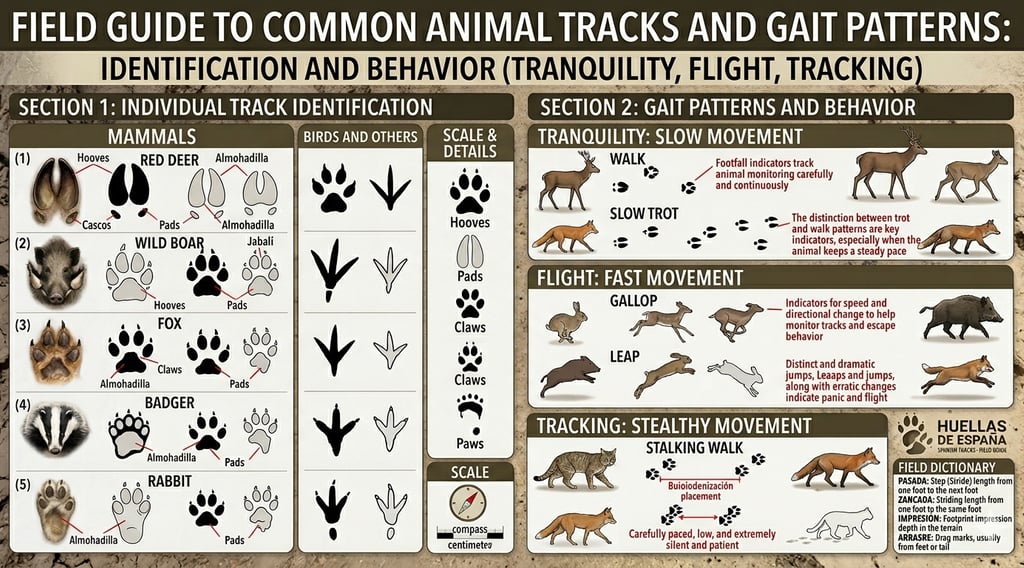
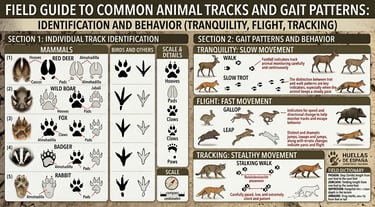
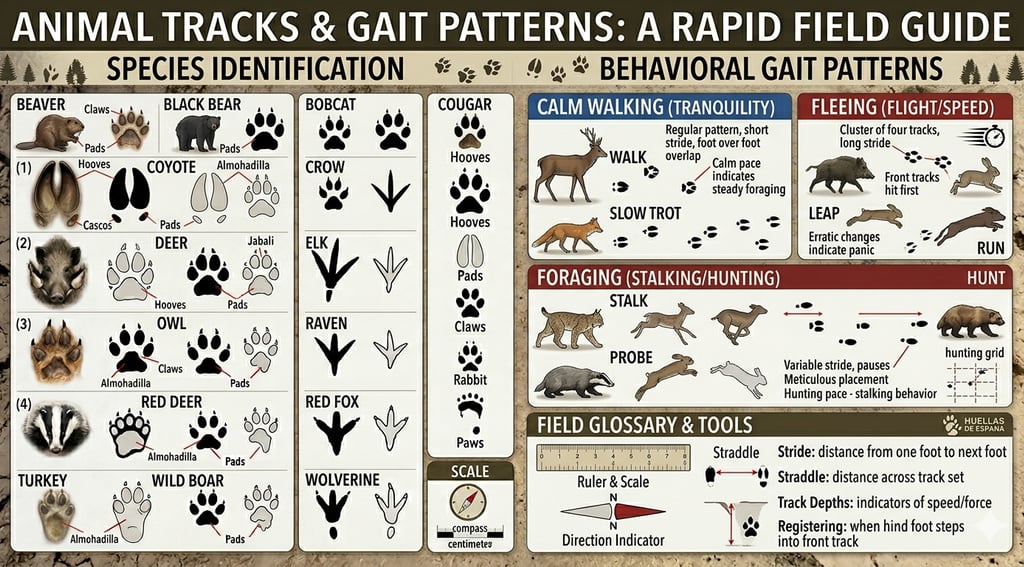
A fresh track has sharp edges, compressed soil and no vegetation growing inside it. The older the track, the more eroded the edges and the drier the interior. But beyond age, the gait pattern tells a complete story: regular, wide strides indicate a calm, walking animal; long and irregular strides suggest flight or running; a zigzag pattern reveals an animal sniffing and foraging.
More important than identifying the species is understanding the animal's emotional state at the moment it passed. That speaks directly to the safety of the environment at that point.
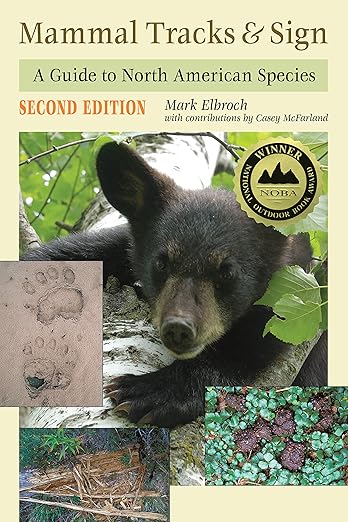
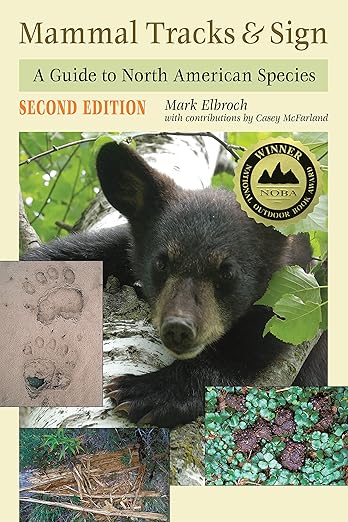
Mammal Tracks & Sign: A Guide to North American Species
Signal 5: Insects as Biological Barometers
Ants foraging with intense urgency signal an approaching storm — they stockpile food before rain arrives. Bees returning precipitously to the hive are a biological pressure gauge — they detect atmospheric pressure drops before any portable instrument. A dense swarm of mosquitoes in a normally breezy area indicates still air, high humidity and possible imminent rain.
The complete absence of insects where they normally exist in abundance indicates strong wind approaching or a drastic temperature change.
Signal 6: Water and Terrain as Risk Guides
The colour and sound of a river communicate what happened upstream. Brown, sediment-heavy water signals recent intense rain at the headwaters — a flash flood may be hours away. The critical warning is rising sound: if the river gets louder and higher without local rain, intense precipitation is falling upstream and a surge can arrive in minutes.
Move away from the bank immediately when you notice volume increasing without an apparent local cause.
Terrain also speaks: spongy ground beneath apparently firm grass is a disguised bog — risk of sinking. Hexagonal cracks in dry soil indicate clay that will become unstable mud with any rainfall.
Personal Water Filter Straw Outdoor Portable Filtration Emergency Survival Gear Water Solutions Tactical Gear for Hiking Camping Accessories Travel Hunting Fishing Outing Backpacking


Signal 7: Reading Urban Environments
Environmental reading isn't exclusive to wilderness. In cities, the same principles apply: people walking faster than normal with no clear destination, shop owners closing outside usual hours, an unusual absence of children and elderly in public spaces — all are signals of imminent tension that a trained observer picks up before any official alert is issued.
A crowd moving in one direction with urgency is fleeing something. Never move against the current — find a lateral exit and assess from a safe point.
The Observation Protocol: The 5-Sense Method
Upon arriving at any new environment, train this two-minute protocol before any action:
Step one: Stop completely and resist the impulse to keep moving.
Step two: Listen for 30 seconds with your eyes closed. Identify each sound separately. How many are natural? Is anything out of pattern?
Step three: Smell the air — damp earth, vegetation, smoke, animal. The sense of smell accesses information that eyes cannot reach.
Step four: Observe in progressive zones — five metres first, then twenty metres, then the horizon. Look for what's out of pattern: what doesn't belong? What is moving? What is too still?
Step five: Touch the ground briefly — temperature, moisture and firmness reveal information about terrain and recent weather.
Practised consistently, this protocol transforms situational awareness from a conscious skill into automatic instinct.
The 4 Most Dangerous Mistakes in Environmental Reading
Trusting a single signal. One isolated signal is coincidence. Two converging signals are a trend. Three signals pointing in the same direction are a fact. Never make survival decisions based on a single environmental indicator.
Interpreting through the lens of your home environment. The same species behaviour can mean different things in different biomes. A bird alarming in tropical rainforest carries different weight than the same alarm in open savanna. Always calibrate your interpretations to the specific environment you are in.
Neglecting night adaptation. At night the entire system changes. Vision loses primacy and hearing and smell must be consciously trained. White light destroys twenty minutes of visual adaptation in seconds — never use it when trying to read a dark environment.
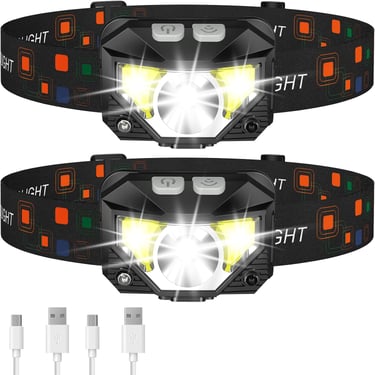
LHKNL Headlamp Flashlight, Lumen Ultra-Light Bright LED Rechargeable Headlight with White Red Light, 2-Pack Waterproof Motion Sensor Head Lamp,8 Modes for Outdoor Camping Running Hiking Fishing
Dismissing urban signals. Many people trained in natural environments completely lose situational awareness in cities. The urban environment communicates with equal richness — learn to listen to it.
Recommended Kit for Serious Environmental Awareness
Building strong situational awareness starts with the senses — but the right equipment amplifies both observation capacity and response precision:
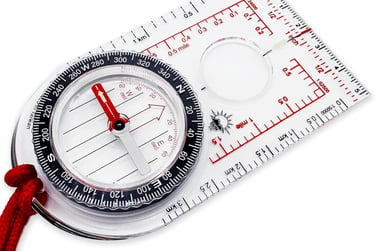
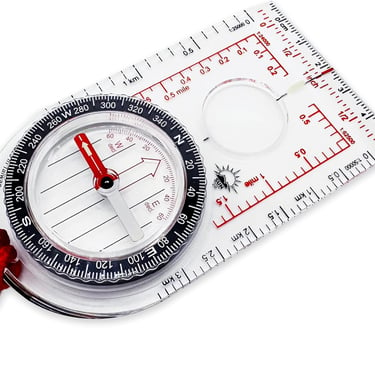
ProMap - Ultra Lightweight Baseplate Map Compass with Declination Scale - Accurate Orienteering Compass for Hiking, Backpacking, Camping, and Survival Navigation
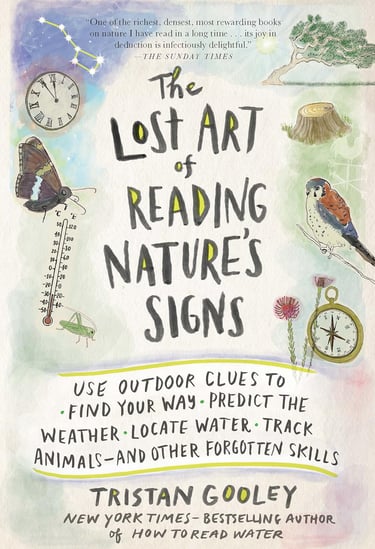
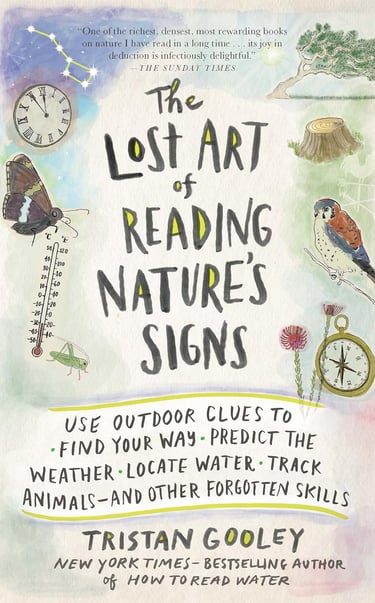
The Lost Art of Reading Nature’s Signs: Use Outdoor Clues to Find Your Way, Predict the Weather, Locate Water, Track Animals―and Other Forgotten Skills...
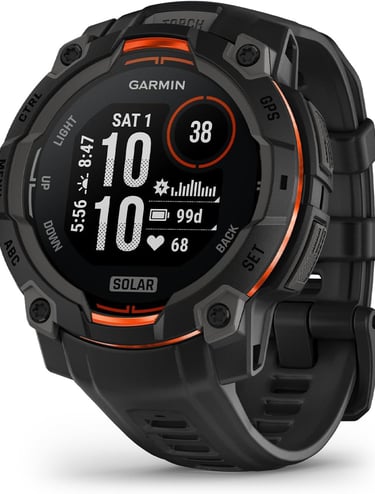
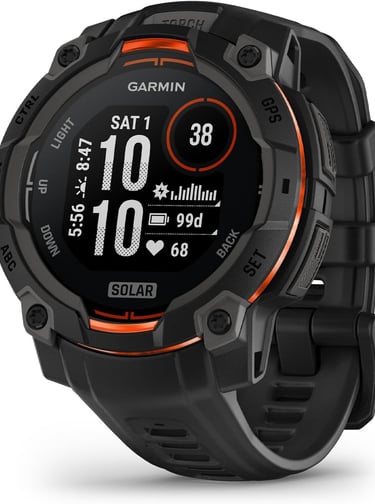
Garmin Instinct® 3 45mm, Solar Charged Display, Rugged Outdoor GPS Smartwatch, Metal-Reinforced Bezel, Built-in Flashlight, Black


Rite in the Rain Weatherproof Side Spiral Notebook, 8.5" x 11", Yellow Cover, Universal Page Pattern (No. 373-MX)
Conclusion: The Environment Always Warns You
Sarah made it back to camp before the storm hit. She had stayed still when the forest went quiet, identified the animal, and understood — for the first time — that the environment had been communicating with her the entire time. She simply hadn't known the language.
Learning to read the environment is learning the oldest language in existence. And like any language, the more you practise, the more fluent you become. Start today: when you leave your house, when you enter a forest, when you cross an unfamiliar city. The signals are always there.
If this guide helped you, save it, share it and come back — there's a lot more survival and preparedness content waiting for you here.
Contact
Contact us for questions or suggestions.
© 2025. All rights reserved.
suportedoisb@gmail.com