



Wound Care and Infection Treatment: The Complete Guide for Any Situation
A poorly treated wound can kill. Not immediately — but slowly, through infection, sepsis and gangrene. In survival situations, accidents or emergencies where medical care is delayed or unavailable, knowing how to clean, treat and monitor a wound correctly is a skill that can save a life.
4/13/20264 min read
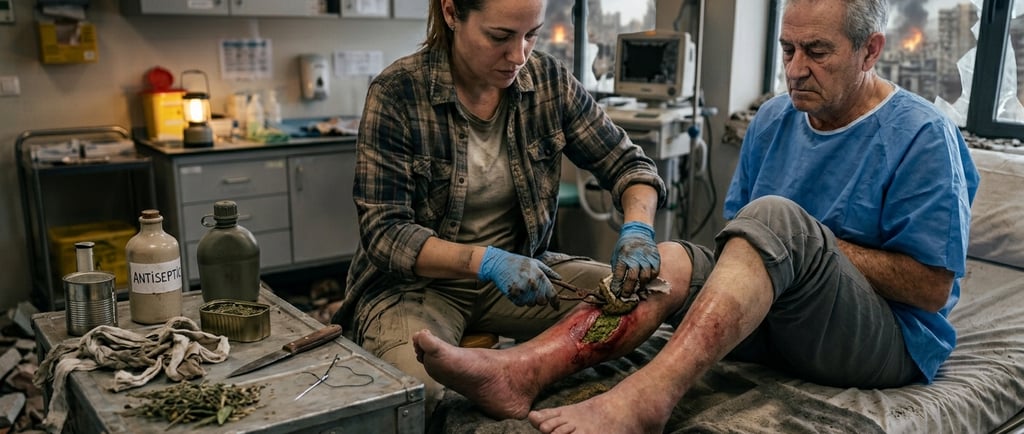
Understanding Wound Types
Incised Wound — clean edges from a sharp object. Bleeds significantly but closes well with lower infection risk if cleaned promptly.
Contused Wound — blunt impact. Irregular, crushed edges. Higher risk of necrotic tissue and infection.
Abrasive Wound — scrape or graze. Superficial but frequently contaminated with dirt and bacteria. Requires thorough cleaning.
Puncture Wound — small entry but potentially deep. High anaerobe risk (tetanus). Extremely dangerous and frequently underestimated.
Avulsion Wound — tissue partially or fully torn away. Requires specialist care but correct first aid makes an enormous difference.
STEP 1 — Wound Cleaning: The Most Important Thing
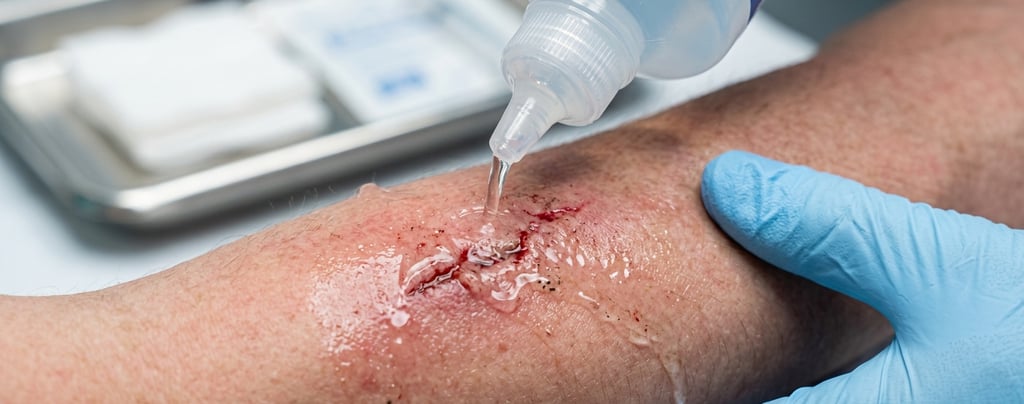
Correct cleaning is more important than any dressing or medication. A wound cleaned with simple materials heals better than a "well-dressed" but dirty wound.
1. Wash your hands first — at least 20 seconds with soap and water, or use hand sanitiser.
2. Control bleeding first — apply direct pressure before cleaning.
3. Abundant irrigation with clean water This is the most underestimated and most effective wound-cleaning step:
Minimum volume: 250 to 500 ml per moderate wound
Serious or contaminated wounds: 1 litre or more
Use pressure (syringe, squeezed bottle, tap pressure) — water pressure physically removes bacteria and debris that no antiseptic can eliminate chemically
Wash from the centre outward, never inward
4. Remove visible foreign bodies with a sterilised tweezers (passed through flame or alcohol). Do not force removal of deeply embedded objects — immobilise and transport.
5. Antiseptic — right and wrong: ✅ Use: Diluted chlorhexidine (0.05%) — the best antiseptic for wounds. Diluted povidone-iodine (0.5–1%) is also effective.
⚠️ Use with caution: Hydrogen peroxide — effective against anaerobes but damages healthy tissue. Use only on initial cleaning, never on healing wounds.
❌ Never apply directly to wound: 70% alcohol, iodine tincture, mercurochrome — they kill the cells trying to heal and delay recovery.
6. Dry gently with gauze or clean cloth using dabbing motions — never rub.
STEP 2 — Correct Dressing
When to cover: exposed to dirt, friction or moisture; wound still wet or with discharge. When to leave open: small, superficial, dry wound or well-formed scab in good-circulation area.
How to dress correctly:
Apply antibiotic ointment (neomycin, bacitracin) if available
Cover with non-stick gauze or inner side of commercial dressing
Wrap with elastic bandage — firm but not circulation-restricting
Change dressing: every 24h for clean wounds; every 12h if discharging; immediately if wet or dirty
Edge approximation (improvised closure): With steri-strips or narrow-cut surgical tape:
Dry the wound edges thoroughly
Gently bring edges together with your fingers
Apply strips perpendicular to the cut, 3 to 5 mm apart
Improvised suture (extreme emergencies only):
Use suture thread or thin monofilament fishing line
Sterilise needle and thread with flame or alcohol
Simple interrupted stitches — never overtighten
Spacing: 0.5 to 1 cm between stitches
Do not suture: wounds older than 6–8 hours, infected wounds, necrotic or dirty wounds.
🎥 Watch: How to clean and treat wounds correctly:

STEP 3 — Recognising and Treating Infection
Infection is the silent enemy of wounds. It starts locally but can spread to the bloodstream (sepsis) within days — and sepsis kills within hours.
Signs of infection — in order of increasing severity:
🟡 Early signs (act now to prevent progression):
Increasing redness around the wound
Swelling and warmth beyond what's expected
Pain that increases rather than decreases after 48 hours
Yellow or greenish discharge (pus)
Unpleasant smell from the wound
🟠 Intermediate signs (urgent treatment needed):
Red streaks spreading from the wound (lymphangitis — infection spreading through the lymphatic system)
Swollen lymph nodes near the wound (armpit, groin, neck)
Fever above 38°C
General malaise, weakness and chills
🔴 Severe signs — MEDICAL EMERGENCY:
Fever above 39.5°C
Mental confusion
Heart rate above 100 bpm
Skin darkening around the wound (necrosis)
Crackling sensation on touch (gas gangrene)
Sepsis kills in 6 to 72 hours if untreated. Any serious sign requires immediate emergency transport.
How to treat local infection:
Intensify cleaning to 3 times per day
Drain pus — gently press wound edges to release content, then irrigate thoroughly
Warm compresses 15–20 minutes, 3 times per day — improve local circulation and immunity
Antibiotics if available — amoxicillin or cephalexin are first-line for skin infections
Immobilise the affected limb and keep elevated
Monitor constantly — if signs worsen in 24–48h, seek urgent medical care
PART 4 — Natural Alternatives When Medications Are Unavailable
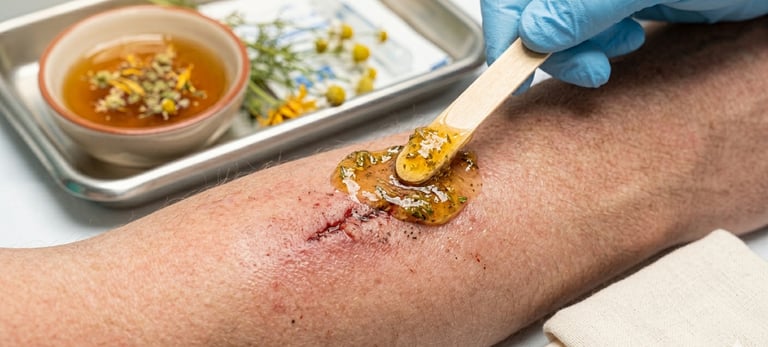
Image for illustrative purposes only
🍯 Raw Honey (The Best Natural Resource)
Multiple mechanisms: acid pH (3.2–4.5) inhibits bacterial growth; osmotic activity dehydrates bacteria; slow-release hydrogen peroxide has antibacterial effect; anti-inflammatory properties reduce swelling. Apply a generous layer of raw, pure honey directly to a clean wound. Cover with dressing. Change every 12–24h. Never use industrially processed honey.
🌿 Plantain (Plantago major)
Fresh leaves, crushed or chewed, applied to wounds have documented anti-inflammatory, antimicrobial and wound-healing properties. Change every 6–8h.
🧅 Garlic (Allium sativum)
Allicin has potent antibacterial activity — including against antibiotic-resistant bacteria. Apply fresh garlic juice lightly to superficial wounds only. Dilute if it causes intense burning. Do not use on deep open wounds.
🌵 Aloe Vera
Internal gel has anti-inflammatory, moisturising and soothing properties. Excellent for burns, abrasions and surface wounds in the healing phase. Change every 8–12h.
🌊 Salt Water (Improvised Normal Saline)
One level teaspoon of salt in 500 ml of boiled and cooled water. Use for abundant irrigation — do not leave salt in prolonged contact with the wound.
🎥 Watch: Natural wound treatments in survival:

Wounds Requiring Immediate Medical Attention
Do not attempt to treat alone if:
The wound is over 2 cm long with separated edges (needs suturing)
Bone, tendon or yellow fat is exposed
Caused by an animal bite (high rabies and infection risk)
Deep embedded foreign body that cannot be removed
Caused by a rusty or heavily contaminated object (tetanus risk)
Any sign of serious infection is present
The victim's tetanus vaccination is not up to date (last 5–10 years)
Minimum Wound Care Kit
Nitrile disposable gloves
Normal saline or sterile water (for irrigation)
Diluted chlorhexidine antiseptic
Sterile gauze and non-stick (vaseline) gauze
Elastic bandages and medical tape
Steri-strips or butterfly closures
Antibiotic ointment (neomycin/bacitracin)
Sterilisable tweezers and scissors
20 ml syringes (for pressurised irrigation)
Thermometer (to monitor fever)
Golden Rules for Wound Care
Cleaning matters more than any medication
Never apply alcohol directly to a wound — it kills healing cells
Change dressings regularly — a wet, dirty wound is a bacterial breeding ground
Always monitor — improving or worsening? If worse in 48h, seek help
Stay hydrated — healing consumes water and nutrients
Never pop burn blisters — they are natural protective barriers
🩹 Correct wound treatment can prevent weeks of suffering or save a life. Share this guide — the right knowledge, at the right moment, makes all the difference.
Contact
Contact us for questions or suggestions.
© 2025. All rights reserved.
suportedoisb@gmail.com