


Fear and Stress Management: How to Keep Your Head When Everything Falls Apart
In the 1980s, the US Army conducted deep research into why some soldiers survived extreme situations while others — with the same physical training, the same equipment, the same conditions — did not. The answer wasn't in their muscles. It was in their minds. The difference between surviving and not surviving a crisis is rarely technical. It's psychological. Panic kills faster than hunger. Despair is more lethal than hypothermia. And fear — when unmanaged — paralyses you exactly when you most need to act.
BARBARA COSTA
4/16/20265 min read


What Happens in Your Brain When You're Afraid
When you perceive a threat, the amygdala — the brain's alarm centre — fires within milliseconds, before your prefrontal cortex (responsible for logical reasoning) has any chance to process what's happening.
This triggers a hormonal cascade: adrenaline surges, cortisol rises, blood is redirected from internal organs to large muscle groups. The result is the fight-flight-freeze response — an ancient evolutionary system, efficient for immediate physical threats but frequently counterproductive in modern crises that require reasoning, planning and decision-making.
The Problem of Freezing
Freezing — the third option — is the most dangerous in survival situations. Studies on disaster survivors show that up to 70% of people experience some degree of freezing in the first moments of a crisis.
The good news: freezing can be trained away — and the techniques below do exactly that.
TECHNIQUE 1 — Tactical Breathing: The Panic Switch
Breathing is the only autonomous body system you can consciously control — and controlling it is the fastest, most effective way to interrupt a panic response.
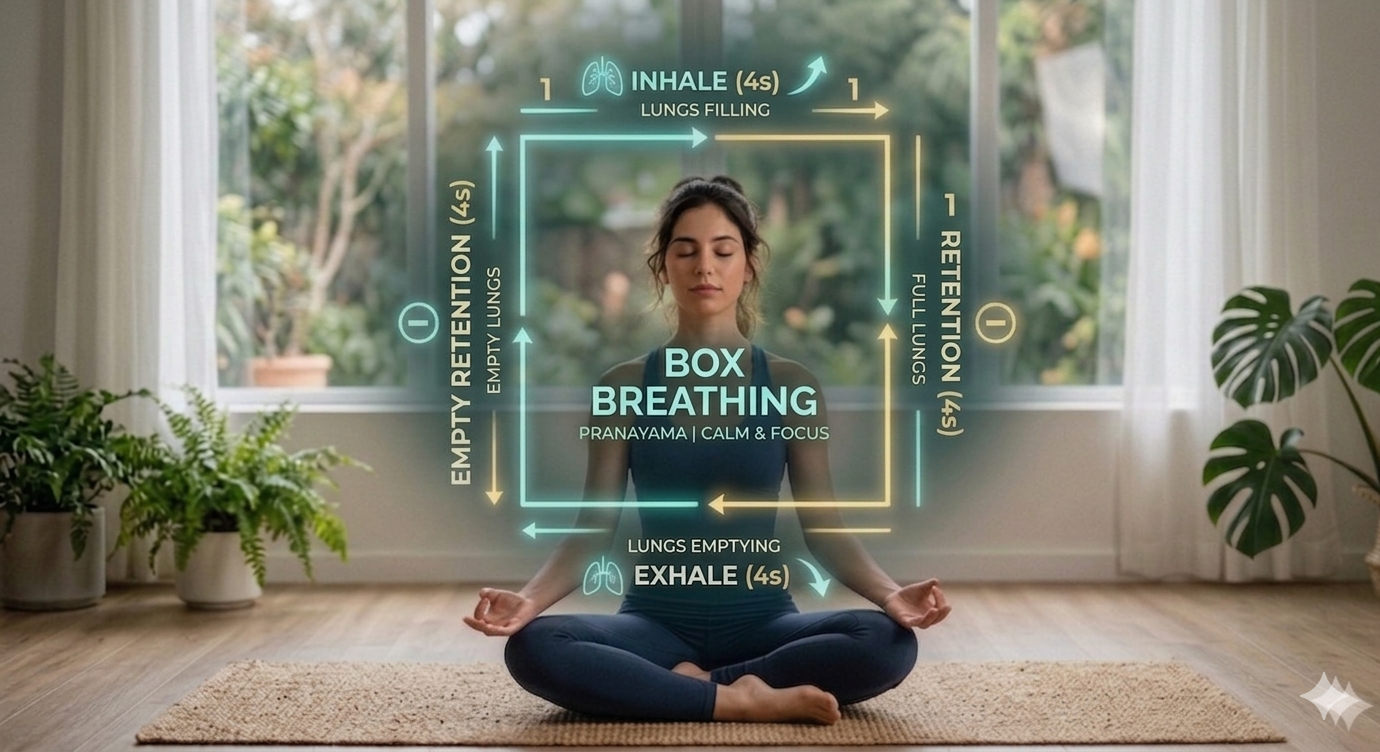
Box Breathing — Used by US Navy SEALs
The most validated stress-control technique used by military special forces worldwide:
Inhale through your nose for a count of 4
Hold for a count of 4
Exhale through your mouth for a count of 4
Hold empty for a count of 4
Repeat the cycle 4 to 6 times
Physiological effect: activates the parasympathetic nervous system ("rest and digest" mode), lowers heart rate, normalises CO₂ and restores access to the prefrontal cortex — returning the ability to think clearly.
4-7-8 Breathing (For Intense Anxiety)
Developed by Dr Andrew Weil:
Inhale through your nose for a count of 4
Hold for a count of 7
Exhale completely through your mouth for a count of 8 (with a soft sound)
Repeat 4 times
Diaphragmatic Breathing (For Continuous Use)
Breathe from the diaphragm — your belly rises on the inhale, not your chest. Practise this in calm moments to make it automatic during crises.
🎥 Watch: Breathing techniques to control panic:

TECHNIQUE 2 — The STOP Method: Breaking the Panic Cycle
S — STOP Physically stop what you're doing. Sit, crouch or lean against something. The physical act of stopping breaks the adrenaline cycle.
T — THINK Observe your thoughts without judgement. "I'm afraid. That's normal. My body is helping me survive." Naming the emotion reduces its intensity — neuroscience calls this "affect labelling" and fMRI studies show it reduces amygdala activity by up to 50%.
O — OBSERVE Assess the situation with your eyes — not your imagination. What is actually happening? What is the concrete threat? Often, what the mind imagines is far worse than reality.
P — PLAN Identify ONE concrete action you can take right now. Just one. The feeling of control — even a small one — is the most powerful antidote to panic.
TECHNIQUE 3 — Grounding: Anchoring to the Present
When the mind spirals into catastrophic thinking ("what if I die here?", "what if no one finds me?"), grounding brings it back to the present moment — where action is possible.
The 5-4-3-2-1 Technique:
Name out loud (or mentally):
5 things you can SEE around you
4 things you can TOUCH — and touch them
3 things you can HEAR
2 things you can SMELL
1 thing you can TASTE
This activates the physical senses and forces the prefrontal cortex to re-engage, interrupting the spiral of anxious thought.
TECHNIQUE 4 — Positive Self-Talk
Studies of extreme situation survivors — shipwrecks, avalanches, captivity — consistently show that survivors do one thing differently: they control what they say to themselves.
Negative self-talk accelerates panic:
❌ "I can't do this"
❌ "I'm lost, there's no way out"
❌ "This is too big for me"
Positive, realistic self-talk stabilises:
✅ "I'm afraid — and that's okay. I've been through hard things before"
✅ "What can I do RIGHT NOW?"
✅ "One step at a time"
✅ "I was prepared for this"
The third-person name technique: research by psychologist Ethan Kross shows that talking to yourself in the third person significantly reduces stress responses. Instead of "I'm afraid", say "[your name] is afraid — and [your name] is going to get through this." It sounds strange — but it works.
TECHNIQUE 5 — Pre-Crisis Mental Preparation: Stress Inoculation
The best fear management starts before the crisis. The military, firefighters and emergency doctors don't wait for a crisis to learn how to handle one — they intentionally train under stress.
Mental Visualisation
Olympic athletes, firefighters and soldiers all use this:
Close your eyes in a quiet moment
Visualise in detail a crisis situation you fear
Visualise how you respond correctly — your actions, your thoughts, your breathing
Repeat the mental film multiple times
The brain does not fully distinguish between real experience and vivid visualisation — every mental repetition creates neural pathways that facilitate the correct response when the real situation arises.
TECHNIQUE 6 — Managing Prolonged Stress
Routine and structure: establish schedules for waking, finding food/water, building/improving shelter and rest. The brain interprets routine as predictability, which reduces the constant state of alert.
Focus on the controllable: ✅ My breathing / my immediate actions / my attitude / how I use my energy ❌ The weather / what others do / what has already happened
Micro-objectives: don't think about "surviving for weeks." Think about "what do I need to do in the next hour." Smaller achievable goals create psychological momentum.
Social connection: if not alone, cultivating connection with others is one of the most powerful resilience factors in crises. Neuroscience shows that social connection activates the same reward circuits as food and water.
🎥 Watch: How to train the mind for extreme situations:

TECHNIQUE 7 — The Power of Rest and Sleep
A sleep-deprived brain loses dramatically its emotional regulation capacity. After 24 hours without sleep, the brain's fear and anger centres are 60% more reactive — making you more prone to panic, rage and impulsive decisions.
In prolonged stress situations:
Prioritise sleep even when the situation seems urgent — a rested brain makes better decisions
20-minute power naps significantly restore cognitive function
Create minimal comfort conditions for sleep — temperature, darkness and protection from the elements
Avoid critical decisions when sleep-deprived — delegate or postpone if possible
The FEAR → FIDO Model
Used in advanced survival training:
F — Face it → Acknowledge the fear. Denying it consumes energy
I — Identify it → What specifically do you fear? Name it precisely
D — Deal with it → What concrete action can you take right now?
O — Own it → You are responsible for your response — not the situation
The 7 Golden Rules of Survival Psychology
Fear is an ally — panic is the enemy. Fear sharpens the senses. Panic blinds them.
Breathe first. Always. No action taken under total panic is effective.
One step at a time. Big problems are solved through small consecutive actions.
Focus on what you can control. Energy spent on the uncontrollable is energy wasted.
Verbalise. Talking out loud — even alone — activates the prefrontal cortex and organises thought.
Care for the body to care for the mind. Sleep, hydration and food are the foundation of mental health.
The will to live is an active choice. History's greatest survivors consciously decided they were going to survive — and that decision changed everything.
The mind is your most powerful tool — and also your greatest vulnerability. Train it like you train your body. Share this guide with anyone facing challenges — in the wilderness or in everyday life.
Contact
Contact us for questions or suggestions.
© 2025. All rights reserved.
suportedoisb@gmail.com