


Cooking Without Modern Infrastructure: Techniques, Methods and Recipes for Any Situation Survival | Camping | Self-Sufficiency | Primitive Cooking
Remove electricity, gas and the supermarket from any equation and what remains is an absolutely fundamental need: we need to cook to survive. Cooking eliminates parasites and bacteria, makes indigestible foods nutritious, increases available calories and transforms raw materials into real energy for the body. The techniques in this guide have been used by humans for hundreds of thousands of years — long before any stove, non-stick pan or gas burner. They are simple, effective and replicable with what nature and the field provide. Keywords: how to cook without a stove, survival cooking, cooking over campfire, primitive cooking methods, camping recipes without equipment
BARBARA COSTA
4/26/20265 min read
🔥 PART 1 — Fire as Your Kitchen
🪵 Types of Fire for Cooking
Ember fire (the best for cooking): Embers are superior to flames for cooking — hotter, more uniform, more controllable and produce less smoke that alters flavour. Produce embers with hardwood (oak, hickory, cherry, apple, eucalyptus) after 30–45 minutes of vigorous fire.
Ideal woods: hardwoods — oak, beech, cherry, apple, hickory. Soft woods (pine, cedar): burn fast and produce resin that alters flavour — avoid for cooking. Never use: treated, painted or engineered wood (plywood, MDF) — releases toxic compounds.
🏕️ Fire Configurations for Different Cooking
Star fire (for boiling water and pot cooking): Arrange 4–5 logs pointing to the centre like wheel spokes. Push logs inward as they burn. Place pot on stone supports at the centre. Control temperature by pushing logs in or pulling them out.
Trench fire (for roasting and fuel economy): Dig a trench 30 cm deep × 20 cm wide. Fire in the trench is protected from wind, directs heat upward and uses far less wood. Ideal for windy locations or when wood is scarce.
Dakota fire hole (maximum efficiency): Two holes connected by an underground tunnel:
Dig main hole 30 cm deep × 20 cm diameter
Dig second hole 30 cm away, connected to the first by an angled tunnel
Second hole acts as air intake — creates convective draft that maximises combustion
Produces almost no smoke and uses very little wood
🍳 Pot Supports Over Fire
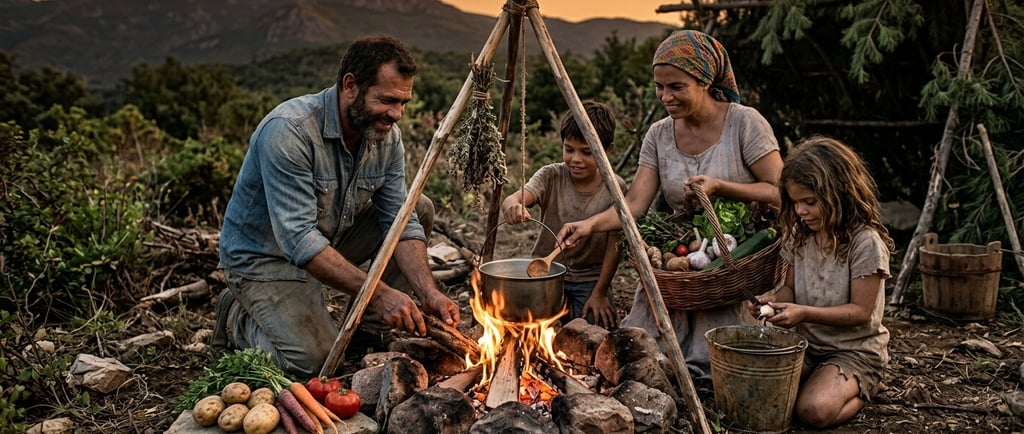
With stones: three similar-sized dry stones arranged in a triangle over the embers. ⚠️ Warning: avoid porous or river-rounded stones — they can explode from trapped moisture when heated. Use dry, dense, compact stones only.
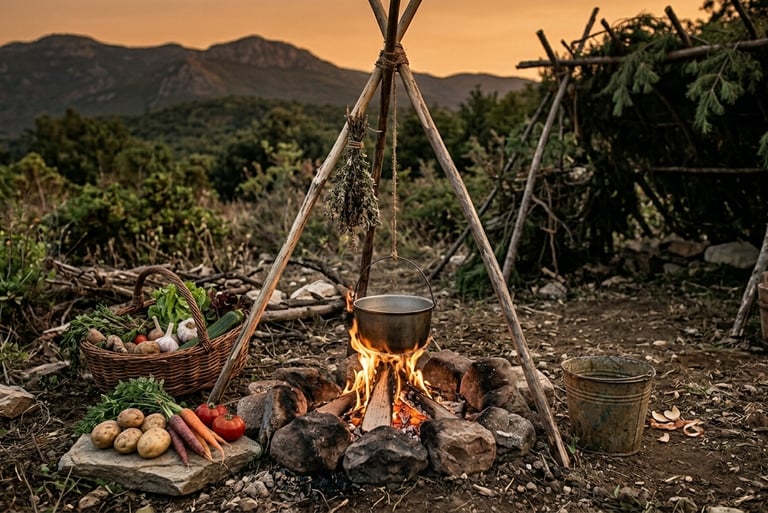
With forked sticks: cut two forked branches and drive into the ground either side of the fire. Lay a horizontal branch across the forks. Hang pot with wire or an improvised hook.
🌊 PART 2 — Boiling, Cooking and Roasting
♨️ Boiling Without a Metal Pot
Stone boiling (used by indigenous peoples worldwide for millennia):
Heat solid, dry stones directly in the fire for 20 to 30 minutes
Prepare a waterproof container: bark bowl, closed bamboo segment, leather, or a hole lined with plastic or hide
Using two sticks as tongs, transfer hot stones into the water
Replace cooled stones with fresh hot ones — the water boils rapidly
Continue until food is fully cooked
This technique can boil 2 litres of water in under 10 minutes.
With bamboo: a green bamboo segment closed at one end is an excellent cooking vessel. Fill with water and food, place over embers at a 45° angle. Green bamboo doesn't catch fire immediately — it lasts long enough to cook the contents.
🥩 Direct Fire Roasting
On a spit:
Use a strong green branch (green = doesn't catch fire easily)
Sharpen one end with a knife or stone
Skewer the meat, fish or tuber
Hold or support over embers at an angle
Rotate regularly — every 2 to 3 minutes
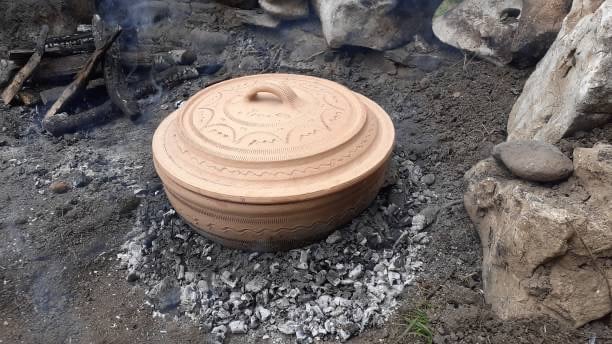
Directly in embers: Tubers (potato, yam, cassava, beetroot) and some fruits (banana, onion) can be placed directly on embers or buried in hot ash.
Place the whole tuber with its skin directly on the embers
Cover with more embers and ash
Wait 20 to 40 minutes depending on size
The skin will be charred — this is protection, not food
Open to find perfectly cooked, flavourful interior
Earth oven (forno de terra) — ancestral slow-cooking technique:
Dig a hole 60 cm deep × 50 cm diameter
Line the bottom with stones
Build a fire inside the hole for 1 to 2 hours to heat the stones and walls
Remove the embers (leave the stones)
Place food wrapped in large leaves (banana, fern)
Cover with more leaves, then soil
Wait 2 to 4 hours — retained heat cooks food by steam and conduction
Result: extremely tender, juicy, uniformly cooked food
🎥 Watch: Primitive fire cooking techniques:
☀️ PART 3 — Cooking with the Sun: Solar Oven
A solar oven is one of the most underrated self-sufficiency techniques. With reflective materials (aluminium foil, mirrors, metallic packaging) and a box, it's possible to reach 120 to 200°C — enough to cook, pasteurise water, bake bread and even fry eggs.
🔆 Box Solar Oven (The Easiest)
Materials:
2 cardboard boxes (one smaller to fit inside the other)
Aluminium foil
Transparent plastic or glass (lid)
Newspaper or insulating material (between boxes)
Stick or wire to hold the reflector lid at angle
Construction:
Line the interior of both boxes with aluminium foil (shiny side facing in)
Place crumpled newspaper between the two boxes as insulation
Fit the smaller box inside the larger one
Create a reflector lid from the flaps lined with foil — angled to reflect sunlight in
Cover the main opening with transparent plastic or glass
Use:
Place a dark-coloured pot inside (absorbs more heat)
Reaches 120–150°C on a sunny day — enough to cook rice, beans, eggs, bread
Pasteurises 1 litre of water in 1 hour
🎥 Watch: How to make a homemade solar oven:

🍳 PART 4 — Improvised Utensils
🪨 Flat Stone as a Frying Pan
A flat, dense, dry stone heated over embers works as an excellent cooking surface.
Choose a flat, solid, dry stone (dense granite, slate, quartzite)
Heat slowly over embers — rapid heating can crack the stone
Test with a water drop: should evaporate instantly when ready
Grease with animal fat, vegetable oil or a banana leaf
Grill fish, meat, eggs and vegetables directly on the surface
🎍 Bamboo as Pot, Cup and Utensils
Pot: segment closed at one end
Cup/bowl: segment cut between two nodes
Skewer: thin sharpened stalk
Spoon: piece carved with a knife
Chopsticks: thin, smooth stalks
🍃 Leaves as Natural Aluminium Foil
Banana leaf: most versatile — handles direct heat, doesn't tear easily, adds mild flavour
Fern: excellent for earth oven
Agave leaf: resistant to extreme heat
Wrapping technique: place food on leaf, add seasoning (salt, herbs, garlic), fold firmly and tie with vine or leaf strip. Place over embers or in earth oven.
🏺 Emergency Containers
Any clean tin can: perfect as an improvised pot
Concave stone: natural depressions can hold water and serve as cooking vessels
Giant bamboo section: excellent for boiling large volumes
Leather or hide: millennial tradition for stone boiling
🧂 PART 5 — Flavour Without a Supermarket
🧄 Wild garlic (Allium ursinum): identical flavour to cultivated garlic. Found in damp, shaded woodland.
🌿 Wild aromatic herbs:
Wild thyme — versatile with meat and fish
Wild oregano — found in open, sunny fields
Wild mint — riverbanks and stream edges
🌊 Salt: if near the coast, boil seawater until completely evaporated — salt crystallises at the bottom.
🍋 Acidity: sour berries, wild fruit juice — enhances flavours and aids preservation.
🍬 Natural sweeteners: wild bee honey, birch or maple sap boiled down to syrup, crushed ripe fruits.
🍳 PART 6 — Basic Recipes Without Infrastructure
🥞 Bread Without an Oven (Australian Damper)
Used by indigenous Australians and explorers for centuries:
Ingredients: 2 cups of flour + pinch of salt + enough water to form a firm dough
Mix until dough doesn't stick to your hands
Spit option: wrap spirally around a strong green stick. Rotate over embers 15–20 minutes
Ember option: flatten to a 2 cm thick disc. Place directly on gentle embers, 10 minutes per side
Earth oven option: wrap in banana leaf and bury for 45 minutes
🫕 Survival Broth
Place in pot or bamboo: animal bones or fish bones + found roots and tubers + wild aromatic herbs + enough water. Boil for 1 to 2 hours. Rich in minerals, collagen and calories.
🐟 Field-Smoked Fish
Build a branch frame over low embers at 60 cm height
Lay cleaned fish fillets on the grill
Cover with green leaves to concentrate the smoke
Smoke for 2 to 3 hours over low heat
Smoked fish lasts 3 to 5 days without refrigeration
🧭 Golden Rules for Cooking Without Infrastructure
Embers over flames — embers are the perfect cooker
Dry stones only — moist or porous stones can explode from the heat
Green doesn't burn fast — use green branches, bamboo and leaves as utensils
Cook thoroughly — without refrigeration, undercooked food spoils fast and can poison
Small, controlled fire — a small hot fire beats a large uncontrollable one
Use residual heat — after the fire dies, embers still cook for 30 to 60 minutes
Contact
Contact us for questions or suggestions.
© 2025. All rights reserved.
suportedoisb@gmail.com